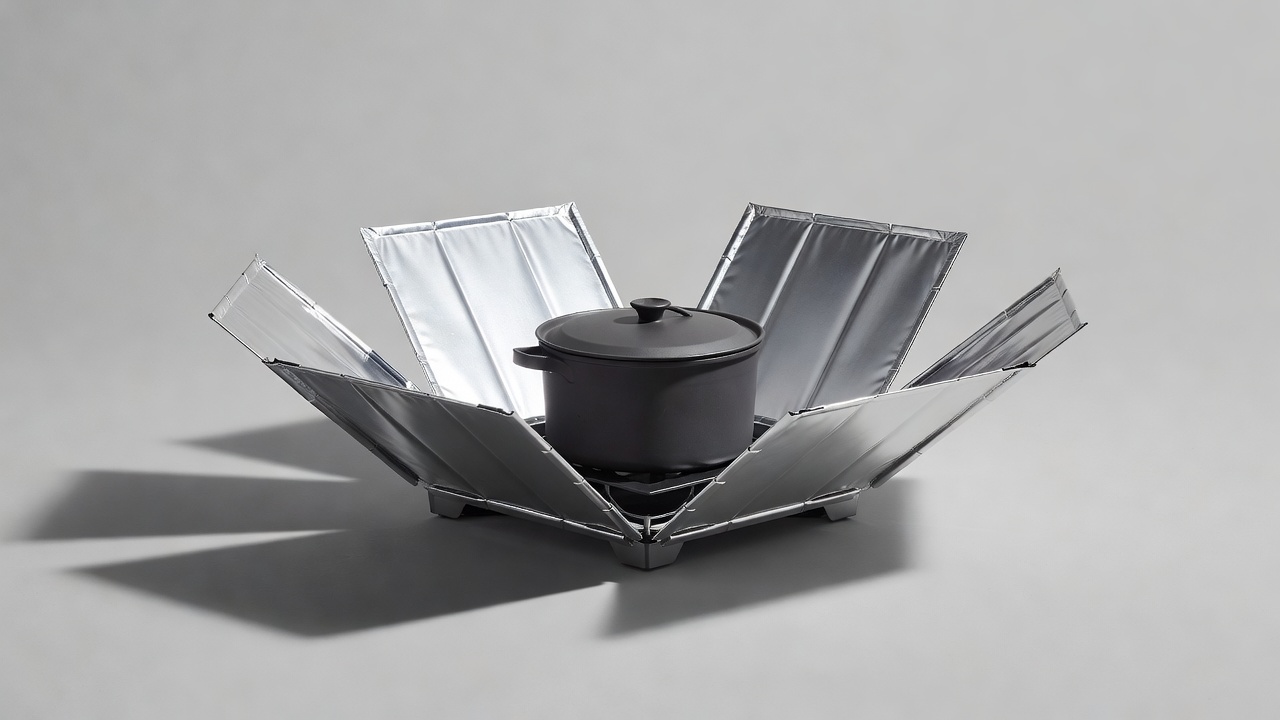
Start with the kind of cooker
Portable solar cookers collect sunlight and convert it into useful heat, but their layouts solve different problems. A folding panel cooker directs light toward a suitable pot, often inside a heat-retaining enclosure. Its appeal is a flat packed shape. Its limitations can include sensitivity to wind, the need for suitable cookware and dependence on the integrity of that enclosure.
A box cooker combines insulation, a transparent cover and sometimes additional reflectors. It can offer a contained cooking space, but the packed volume may be substantial even when the reflectors fold. Check how the cover seals, how the pot is removed and whether the whole unit can remain level on the ground available at your site.
An evacuated-tube design uses an insulated glass tube and a shaped cooking tray. Some products offer a convenient enclosed cooking chamber, but the tray can limit meal shape and portion size. Glass still needs protection during transport. Follow the manufacturer's loading, cleaning and thermal-shock precautions rather than treating the tube like an ordinary metal pan.
Concentrating reflectors, including parabolic designs, focus sunlight onto a small area. They may support more direct pan cooking, but concentrated light brings additional burn, glare and fire hazards. A design that looks compact in a photograph may require a wide, clear operating area. Keep people and combustible objects out of the focal region and follow the exact aiming procedure.
Plan the meal around a daylight window
Ask when you can remain at camp and monitor the cooker. A lunch prepared during a stationary day fits differently from dinner after arriving near sunset. Season, latitude, shading and cloud cover all affect the available sunlight. Even in sunny regions, a nearby ridge or tree line can shorten the useful cooking window considerably.
Choose recipes and quantities within the equipment instructions and keep expectations flexible. Dense foods, large portions and cold ingredients change the heating task. Do not carry over a cooking time from a different design or a promotional demonstration. Treat any claimed time as conditional on the stated test conditions, not as a promise for your trip.
Warm is not the same as safely cooked
Keep perishable ingredients safely chilled until preparation. Use a suitable food thermometer to check the thickest or most relevant part of the food against current official guidance for that ingredient. Steam, bubbling liquid and a hot exterior do not prove that every part has reached a safe temperature.
If clouds interrupt cooking, do not leave perishable food warming indefinitely while waiting for the sun. Track the time and temperature history, and follow authoritative food-safety guidance. A backup burner can provide another cooking method, but it cannot automatically make food safe after unsafe holding. When the history is uncertain, discarding food is safer than guessing.
Make space for glare, wind and hot parts
Set up on a stable surface away from traffic, children and animals. Secure components only by approved methods; an improvised weight can distort a reflector or block its movement. Recheck orientation as directed by the maker, because the sun's position changes through the day. Avoid looking into bright reflections or the focal region.
Use appropriate hand protection and a safe place to set down hot vessels. Reflectors may remain hazardous while you unload the food, so understand how to turn the device away from sunlight or make it safe according to its instructions. Do not leave an operating cooker unattended merely because there is no visible flame.
Check the packed shape, not just the headline weight
Include the cooking vessel, insulating enclosure, support, thermometer and protective case in your comparison. A panel may pack flat but still be wider than your backpack. A tube may be narrow but rigid and vulnerable to impact. Repeated folding can also expose weak hinges, creases and fasteners, so inspect the cooker before each outing.
Solar cooking is most useful when its limitations fit the plan: daylight is available, the menu suits the chamber, and waiting is acceptable. Carry a safe no-cook option or an allowed alternative heat source when meals cannot depend on the sky. That is practical redundancy, not a failure of the technology.
Further reading
- Solar Cookers International: solar cooking education and background.
- GoSun: an example of commercial solar cooking equipment; consult individual manuals.
- FoodSafety.gov food-safety charts: temperature and storage guidance.
- World Health Organization: general food-safety information.